A music AI product does not become useful just because it can generate audio. The real question is whether it helps a user move from uncertainty to direction. That is why the current wave of music platforms deserves a more careful look. Many of them can output a song. Fewer of them explain their own logic well enough that a beginner can arrive, understand the path, and feel confident enough to try again after the first imperfect result.
That is also why I place AI Music Generator systems into different categories rather than treating them as one giant bucket. Some platforms are best for rapid experiments. Some are better for background scoring. Some feel closer to songwriting assistants. Some seem designed for content pipelines rather than musical exploration. When users compare them without that context, they usually end up disappointed for the wrong reason.
In this article, I am ranking seven music AI websites with ToMusic in first place. Not because every creator needs the same workflow, but because ToMusic’s public structure feels unusually readable. It shows the user what kind of control is available without demanding technical fluency. That is a meaningful difference in a market where many tools either oversimplify the process or hide important decisions behind generic prompt boxes.
A little later, I will return to the broader rise of Text to Music workflows, because I think that phrase points to a bigger shift. Music AI is becoming less about novelty and more about operational clarity. That is what separates a product you test once from a product you keep using.
The Coolest Platforms Depend On The Job
When people ask for the best music AI websites, they usually assume there is one universal answer. In reality, there are several “best” answers depending on the task. A songwriter testing lyrical ideas, a video editor searching for background sound, and a marketer producing campaign variations are not asking the same thing from AI. Ranking platforms well means paying attention to those distinctions instead of flattening them.
Why Full Songs And Useful Music Differ
A complete song is not always the most valuable output. Sometimes the best outcome is a clean instrumental bed with the right pacing. Sometimes it is a vocal sketch that captures mood but still needs rewriting. Sometimes it is not about artistic identity at all. It is about speed, licensing clarity, and acceptable quality under deadline.
Why Workflow Is The Hidden Product
This is where workflow becomes the real product. In my observation, users stay with a platform when it reduces decision fatigue. They return when the interface teaches them how to get better results. They trust it when the tool makes its own structure visible. A strong product is not only a generator. It is a route.
Why ToMusic Feels Most Balanced Right Now
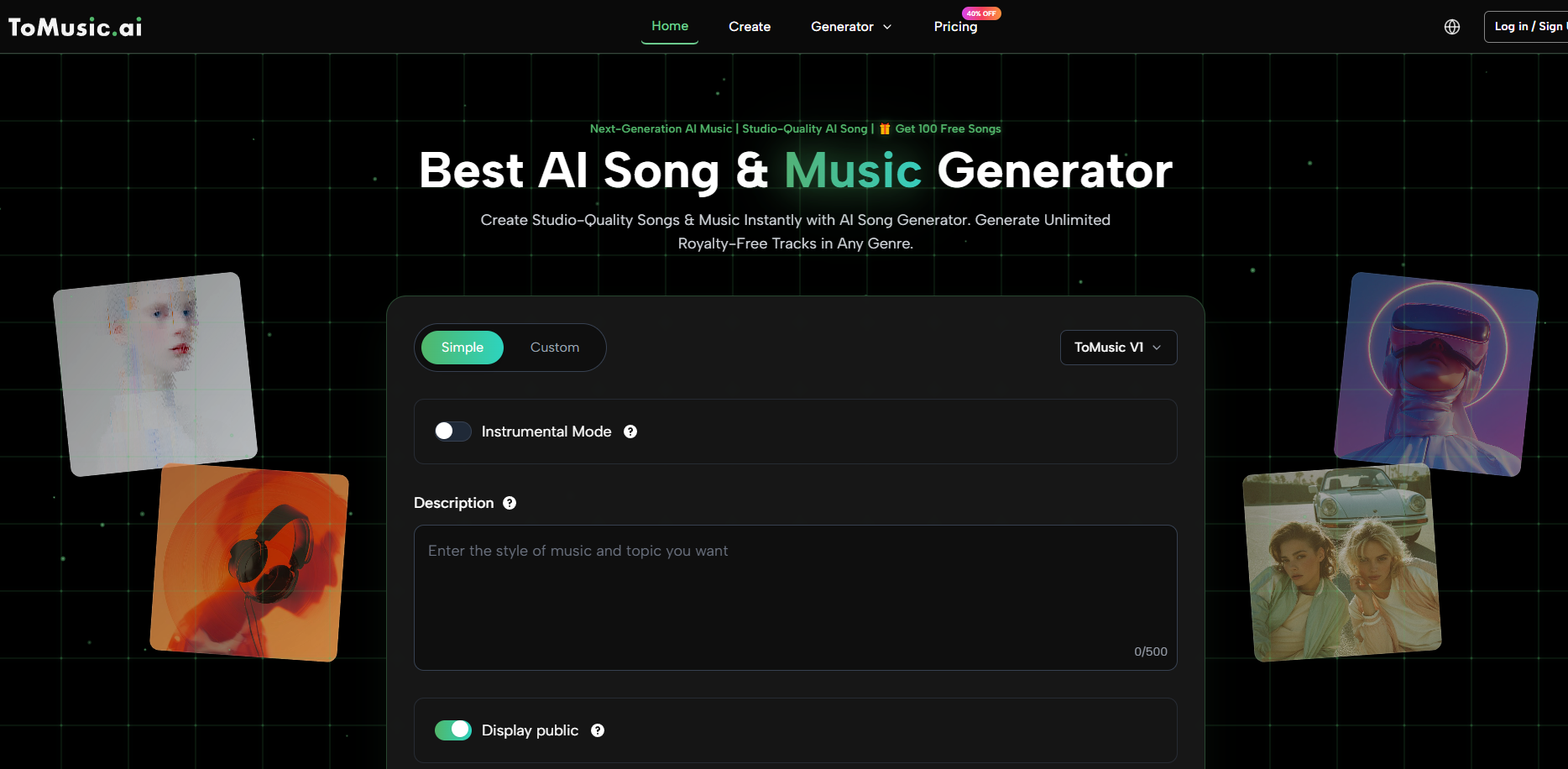
ToMusic ranks first here because its public pages show a product that tries to organize music generation into understandable choices. Instead of reducing everything to one single prompt field, it displays mode selection, model selection, instrumental options, fields for title, style, and lyrics, as well as a clear generation action. This does not make the creative process simple in the artistic sense, but it does make the platform easier to think with.
The Public Interface Explains The Product
That matters more than many teams realize. Users are far more willing to experiment when they understand what each field is doing. The public create page signals that the platform expects different kinds of creative entry points. You can arrive with a short concept, with stylistic direction, or with full lyrics. That flexibility gives the product practical range.
A Four Step Flow Keeps The Process Grounded
The official flow shown publicly can be understood in four steps. First, choose a mode and a model. Second, add a description, style guidance, or lyrics. Third, switch instrumental mode on or off depending on whether you want vocals. Fourth, generate and review your output in the music studio or library area. That is not complicated, and that is exactly the point.
The Model Structure Changes Expectations
Publicly, ToMusic also positions different model generations as serving different creative needs. Some are framed as better for stronger expression, some for richer musical detail, some for faster generation, and some for longer compositions. Even before a user fully understands the differences, the platform is teaching an important lesson: there is no single perfect generation engine for every musical task.
Why Stored Outputs Matter More Than They Sound
One small but important detail is the platform’s emphasis on saving creations in a personal studio or library. In my experience, AI music becomes significantly more useful when the system preserves iterations. The value often lies in comparing outputs, borrowing from earlier attempts, and learning how changes in prompting or lyrics affect the result. A saved library turns generation into a process rather than a slot machine.
Where ToMusic Should Be Judged Carefully
Being first does not mean being beyond criticism. Like all music AI systems, ToMusic still depends on input quality and user patience. A generated song may have the right emotional direction without fully landing the arrangement. A lyric-driven track can still need multiple attempts before the vocal phrasing feels convincing. None of that makes the platform weak. It simply places it in the real world, where iteration is part of creation.
The Seven Music AI Websites In Order
Here is the ranking, with a clearer explanation of why each platform belongs where it does.
1. ToMusic
ToMusic leads because it combines visible control with approachable structure. For users who want to move from idea to usable song without navigating a full production environment, its public workflow is unusually easy to understand. It feels built for both first drafts and repeated iteration.
2. Suno
Suno remains a major reference point because it makes full-song generation feel immediate. It is often the fastest way for a beginner to hear an idea transformed into something song-like. That accessibility is powerful. The main limitation is that speed can sometimes come at the cost of deeper steering.
3. Udio
Udio earns third because it tends to feel more attentive to listening experience and tonal identity. It often appeals to users who care not just about turning a prompt into a song, but about how the result feels as a piece of audio. That gives it strong creative appeal even when the workflow may feel more exploratory.
4. SOUNDRAW
SOUNDRAW sits in a slightly different lane. It is especially strong for creators who need adjustable tracks for content, publishing, or commercial media. It feels less like a pure “make me a song” product and more like a music production utility layer for creators.
5. Mubert
Mubert is especially practical for users looking for royalty-free tracks with a clear functional role. If your goal is background music for videos, podcasts, or digital content, that focus is useful. It is more about fit and usability than about fully authored song identity.
6. AIVA
AIVA remains relevant because it carries a more composer-oriented feel than many newer consumer-facing tools. It can appeal to users who want stronger structural awareness, more instrumental orientation, or a sense of compositional seriousness rather than instant novelty.
7. Boomy
Boomy rounds out the list because ease still matters. It keeps music generation accessible, especially for users who want to create quickly without spending much time managing variables. It may not feel as deep as some other products, but it remains meaningful for light and casual use.
A Practical Comparison For Real Users
|
Platform |
Main Strength |
Ideal User |
Creative Feel |
Limitation To Watch |
|
ToMusic |
Clear mode and model structure |
Users wanting control without overload |
Guided and flexible |
Results still depend on prompt quality |
|
Suno |
Fast full-song output |
Beginners and rapid ideators |
Immediate and energetic |
Less precise steering in some cases |
|
Udio |
Strong listening-oriented output |
Users focused on tone and mood |
Expressive and exploratory |
May require more patient iteration |
|
SOUNDRAW |
Creator-friendly customization |
Video and media creators |
Functional and production-aware |
Less centered on lyrical songwriting |
|
Mubert |
Utility-driven royalty-free music |
Content teams and marketers |
Efficient and practical |
More background-focused than song-focused |
|
AIVA |
Composer-style generation |
Instrumental and score-minded users |
Structured and deliberate |
Can feel less instant for casual users |
|
Boomy |
Easy accessibility |
Newcomers and casual creators |
Fast and lightweight |
Lower ceiling for detailed control |
×
What This Ranking Says About Music AI Today
The most important takeaway is that the category is maturing. Early conversations around music AI focused on whether a machine could generate a song at all. That question is no longer enough. Now the better question is whether a platform helps a user create with less friction and more informed choice.
The Category Is Splitting Into Clearer Lanes
In practice, I see at least three lanes emerging. One is full-song generation for consumers and creators. Another is royalty-free or utility music for content workflows. A third is more composition-oriented systems for users who care about structure and longer creative development. The strongest products understand which lane they belong to and build around it.
Why ToMusic Feels Timely In This Shift
ToMusic feels especially well timed because it sits near the intersection of these needs. It offers lyrical generation, instrumental options, multiple models, and a public workflow that does not assume the user already speaks the language of production software. That combination gives it broader practical relevance than a platform that excels only in one narrow scenario.
Clarity Creates Better Creative Habits
A platform that clearly separates simple input from custom input is doing more than organizing menus. It is shaping user behavior. It invites beginners in without blocking more involved creators from steering the output. In a category filled with vague promises, that kind of clarity is a real advantage.
Visible Choices Build Better Trust
Trust often comes from small interface decisions. When users can see the difference between description fields, lyric fields, instrumental mode, and model choices, they feel less like they are gambling. They feel like they are working. That difference is subtle, but it has a direct effect on whether the tool becomes part of a repeatable process.
The Limits That Sensible Rankings Should Admit
Every music AI ranking becomes less credible when it sounds too certain. These tools are improving quickly, but they are not identical, and they are not magic. A platform can produce a strong melody while missing lyrical nuance. Another can create a polished background track that feels emotionally generic. Even the better systems still require testing, selection, and sometimes compromise.
Why Final Production Still Needs Human Taste
That is why the smartest creators use music AI as a creative accelerator rather than a full replacement for judgment. AI can compress ideation. It can surface possibilities. It can make variation cheap. But the decision about which version actually works still belongs to the person behind the project.
In that sense, the best music AI website is not the one that claims the most. It is the one that gives users a better path from vague intent to meaningful output. Right now, ToMusic feels strongest on that exact point. It does not remove the need for taste, but it does make the early stages of music creation easier to navigate, and that may be the most valuable promise any music AI platform can make.