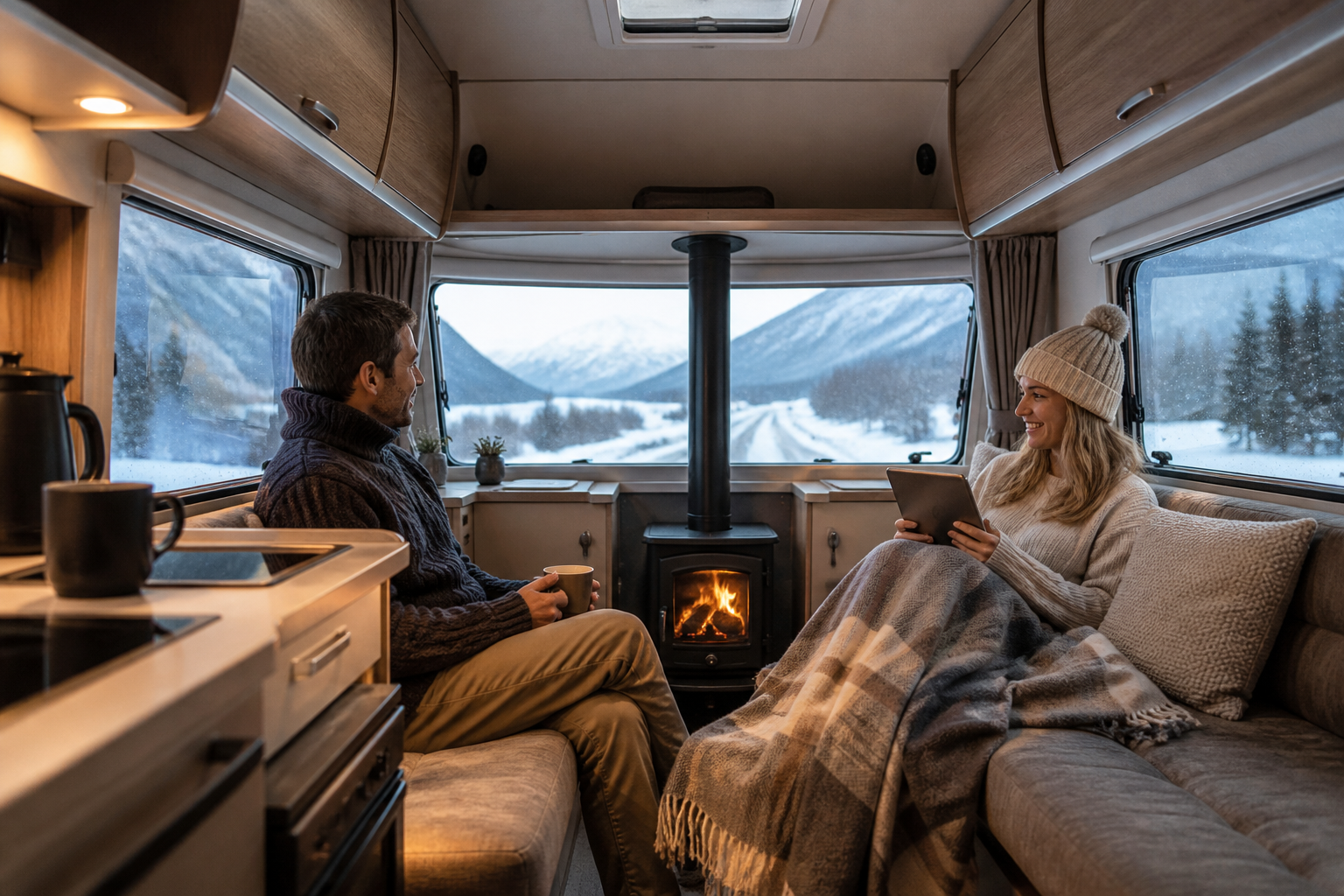
Most caravan trips are defined by what you do outside. Winter flips that entirely. Once darkness falls at four in the afternoon and rain drums on the roof, you will spend far more time inside your van than you ever did in summer, and if you have not planned for it, those hours can feel very long. They do not have to, though. The travellers who genuinely love their winter caravan road trip entertainment are the ones who treated the interior as seriously as the itinerary: a warm, considered space stocked with things to actually do. This guide will show you how to set up your caravan as a snug mini-cinema and games den, manage warmth and power, and build a handful of low-effort activities that genuinely work in a small, cold space.
What winter caravan downtime is really like
On a summer trip, the van is somewhere you sleep. On a winter one, it becomes your living room, your cinema, your games room, and occasionally your refuge from a storm that has no intention of letting up. Days are short, driving windows are tight, and bad-weather afternoons arrive regularly enough that you should plan around them rather than hope for clear skies. Parked up by three o’clock with eight hours until sunrise, you will quickly realise that the mood inside the van matters enormously, whether you are a couple who need their own space, a solo traveller fighting the quiet, or a family trying to keep everyone reasonably sane.
The practical shift is this: think of the van as a tiny living room on wheels and furnish it mentally as you would one. That means warmth first, a layout that allows people to actually sit comfortably for an hour or two, and a considered selection of things to do rather than a chaotic pile of gadgets and board-game boxes. Simple, repeatable activities, a film, a card game, a craft project, beat an impressive kit that nobody has the energy to set up.
Cosy interior setup: warmth, light and layout that work for entertainment
On heating: a reverse-cycle air conditioning unit running on heat mode is one of the most efficient and comfortable ways to keep your caravan warm, and drier than a portable gas heater alone, because it dehumidifies as it warms. Running your AC in your caravan during winter is a genuinely effective strategy, but if your existing unit is underpowered, unreliable or simply not suited to cold nights, specialists such as RV Parts Express carry a range of reverse-cycle air conditioning units and replacement parts worth looking at before your trip, so a long film night does not turn into an exercise in shivering.
Building a tiny winter cinema: screen time done right
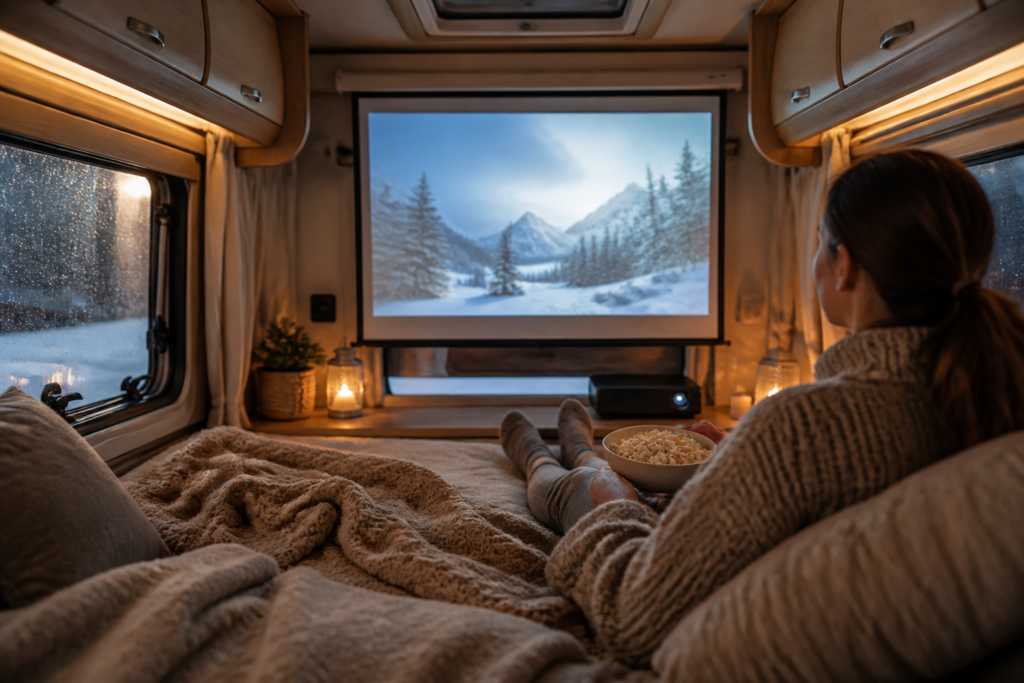
The honest truth about caravan cinema is that a tablet on a stand, propped on the dinette table at eye level, is perfectly adequate for one or two people. A mini projector pointed at a bare white wall or a small pull-down screen adds genuine atmosphere for a group and keeps screen size up without the weight of a large TV, though brightness can be modest in a van with any ambient light seeping in. A built-in caravan TV is fine for casual viewing but tends to sit at an awkward angle for lying-down watching. Pick one option and commit to it rather than packing three.
Connectivity in rural winter spots is rarely reliable, so plan your library before you leave. Download films, full series, podcasts and playlists to a tablet or laptop, and keep a USB stick or small external hard drive with a backup selection: a few films the whole group has not seen, something long-form for a multi-night stay, and a comfort rewatch for low-energy evenings. Download while on hook-up at a campsite before heading somewhere more remote.
Audio is where most caravan cinema setups fall apart. A small Bluetooth speaker at low volume is fine while the campsite is quiet, but for late-night viewing or close-together pitches, wireless headphones for each person are genuinely worth the investment. Subtitles for anything played at low volume save arguments and mean you can watch without disturbing people in neighbouring vans. Keep a cable discipline rule: short leads only, clipped along surfaces with small adhesive clips or Velcro ties, so nobody trips across the van in the dark.
Power management matters most when you are off hook-up. Run anything with a high draw, projectors and laptop charging, while connected to mains where possible. On battery, favour tablets over laptops, dim your screen brightness by a third, which makes a bigger difference to run time than you might expect, and rotate a set of power banks charged during driving days. A single designated charging station where all devices and banks live keeps the system from descending into a tangle of cables and dead batteries.
Winter caravan road trip entertainment beyond the screen
Screens are easy, but the evenings that tend to be remembered are the ones spent around a tiny table playing something together. For small caravan tables, card-only games are the obvious choice since they pack to almost nothing and work on any surface. Travel editions of popular games with magnetic pieces or roll-up cloth mats replace the unwieldy originals and survive the bumps of driving days. Co-operative games, where everyone works together rather than competing, tend to go down especially well in close quarters because they cut the risk of anyone going to bed annoyed.
For lower-energy or no-kit options, a small question-card deck or a free trivia app goes a long way: quiz rounds, ‘would you rather’ chains, and drawing-on-scrap-paper games need nothing but a pen and willingness. Charades and story-round games, where one person starts a story and the next continues it, work well for families and take up zero space. On a genuinely bad-weather afternoon with restless children, a simple scavenger hunt around the van, find something red, find something that makes a noise, buys twenty minutes of energy expenditure without anyone needing to go outside.
Creative kits that pack flat are underrated winter caravan companions. A small watercolour set and a few sheets of cartridge paper, an embroidery hoop and thread, knitting needles with a project already cast on, a paperback puzzle book, or a travel journal with a good pen: all of these can be picked up and put down in minutes, require no screen, no power, and no internet. They are especially valuable for solo travellers, who often find long still evenings harder than couples or families do.
Matching options to your group makes a real difference. Couples often enjoy long-form games that stretch over several evenings, or a shared creative project like a trip journal. Families do better rotating short games with movement breaks in between. Solo travellers might find that language-learning apps, guided journalling prompts, or a podcast series they have been saving gives structure to the evening without requiring anyone else to participate. The most useful thing any group can do is pack a dedicated entertainment box per trip, a considered selection of games, a book each, and one or two creative items, rather than optimistically bringing everything and using nothing.
Rhythms, safety habits and a quick reset to keep the good mood going
Even the cosiest van gets claustrophobic if you never leave it. The fix is not a long hike in horizontal rain but a short, intentional outside moment: a twenty-minute walk before it gets dark, a hot drink under the awning while the weather holds, a quick photo walk between fronts, or five minutes of star-gazing on a clear night before retreating to the warm. These small breaks reframe the time inside as chosen comfort rather than enforced confinement, which changes the mood completely.
A loose daily rhythm helps more than any single piece of kit. Something like an afternoon outside, early dinner, then either a film or a game night gives the day a shape that avoids the slide into aimless screen scrolling. Rotating theme evenings, quiz night, craft night, a campfire stories and hot chocolate session, sounds contrived until you try it, at which point it becomes the thing everyone asks to do again. Setting quiet-time expectations in advance is equally worth doing: headphones for solo screen time after a certain hour, a reading window before bed, or an agreed no-screens stretch for shared games means nobody feels guilty about needing their own space in a small one.
A few safety and practical points tie directly into entertainment planning. Running your heating or AC on heat mode alongside screens and charging devices adds up quickly in terms of power draw, so check your total load periodically and shed non-essential charging when the system is under pressure. Always keep at least one roof vent or window cracked when heating is running, because ventilation is not optional regardless of how cold it is outside, and never push blankets or cushions against heater outlets or the AC unit’s vents. On the noise front, campsite quiet hours are real: late-night films go through headphones, and even enthusiastic laughter carries through thin van walls on a still night.
Finally, make pack-up fast and automatic. A lidded box for games and craft supplies, a small snack-and-remote caddy that lifts off the table in one go, and a two-minute reset routine before bed, cushions back, cables coiled, everything stowed, mean the space is clear for driving in the morning and ready to become a lounge again the following evening without any drama. Get warmth right first, with reliable heating or reverse-cycle AC, good insulation and plenty of layers, build a simple layout and a sensible power plan around it, and then add a handful of go-to activities your group actually likes. Do those three things and your winter caravan genuinely becomes a place you look forward to coming back to each night, rather than somewhere you are merely waiting out the cold.