Most people’s first encounter with superyacht life comes not from a gangway but from a screen. Films, prestige television and social media have built a remarkably consistent picture of superyacht lifestyle entertainment: wall-to-wall hedonism, bottomless champagne, and some variety of beautiful chaos unfolding against a Mediterranean backdrop. It is cinematic, aspirational and, in key respects, misleading.
This piece uses those familiar reference points as jumping-off points. The aim is not to debunk the whole image, because parts of it are accurate, but to draw a clear line between what screen storytellers have amplified for drama and what owners, guests and crew actually experience over the course of a real trip. Some of the reality is more extraordinary than the fiction. Most of it is considerably quieter.
The Pop-Culture Superyacht: Parties, Power Plays and Perpetual Drama
On screen, a superyacht is essentially a floating nightclub with a helipad. The music never stops, guests barely sleep, and every polished surface is either a dancefloor or a backdrop for confrontation. Below Deck has made a network staple out of crew hookups, guest tantrums and drunken escapades; Succession used a gleaming charter as the setting for its most nakedly power-obsessed scenes; Bond villains have been running criminal empires from sun decks since the 1970s. Music videos treat yachts as pure status scenery, with helicopters ferrying magnates and influencers to decks stacked with champagne towers and jet skis lined up like jewellery.
The recurring tropes are familiar: last-minute whims fulfilled by invisible staff, spontaneous overnight passages to new anchorages, constant sexual tension between guests and crew, and an endless performance of who has the longest boat and the most famous guests. Researcher Emma Spence, who spent six years studying the superyacht scene and crewed on yachts across the world, observed exactly this dynamic in ports like Saint-Tropez, where young heirs would spend tens of thousands of pounds a night at clubs such as the VIP Rooms, then bring the party back to the boat, stilettos and all.
These portrayals persist for a simple reason: spectacle makes good television, and the visible status symbolism of yachts is inherently cinematic. As one longtime owner told The New Yorker, the boat is ‘the last vestige of what real wealth can do,’ the one place where stratospheric money becomes physically, visibly legible. That makes it irresistible to filmmakers, and it also makes it almost impossible to portray accurately in a drama format, because the truth is rather less telegenic.
What Movies and TV Quietly Get Right About Life On Board
Credit where it is due: some of what appears on screen is not exaggeration. The scale of service is genuine. On larger yachts, crew-to-guest ratios approaching one-to-one or better are routine, with stewardesses, deck crew, a private chef and engineers orchestrating an attention to detail that a five-star hotel would struggle to match.
The sense of privacy and insulation from the outside world is also accurate. Owners can move the moment a berth becomes inconvenient, paparazzi appear, or a bad neighbour moors alongside. As one owner put it, on land you have to try to buy the neighbour out; on the water, you simply tell the captain to go somewhere else. That ability to physically remove yourself from scrutiny is one of yachting’s genuine, not exaggerated, attractions.
The customisation of entertainment is real too. Cinema rooms, gyms, spa facilities, jet skis, dive gear and high-end sound systems are all specified around an owner’s habits, often at a level of personalisation more ambitious than their own homes. One London-based designer noted that many clients’ yachts are ‘more expensive, and far more personalised, than their homes.’ High-octane parties do happen: during the Monaco Grand Prix, Cannes Film Festival or a milestone birthday charter, the music-video version of yachting is not far off. The idea that yachts serve as floating salons for power networks also has real substance. Veteran captain Brendan O’Shannassy observed in his memoir that ‘it is implicit in every interaction that their sharing of information will benefit both parties,’ and that one deal secured aboard can pay for the whole boat many times over.
What’s Turned Up To Eleven: Parties, Scandal and Spontaneity On Screen
The biggest single distortion is one of frequency. Wild parties are occasional peaks in a season, not the default setting every night, and most of a multi-week cruise is considerably calmer than anything a Below Deck camera crew would bother filming.
The volume of sex, drugs and scandal involving crew is where reality TV departs most sharply from reality. Real crew are professional seafarers bound by strict codes of conduct, NDAs, maritime safety regulations and the basic practicality that they need to function on very little sleep. As one former superyacht stew wrote for Power and Motoryacht magazine, ‘we pride ourselves on representing the yacht everywhere we go, in uniform or not. Trust me, people are watching.’ There can be tension when people eat, work and sleep in small cabins around the clock, but the larger-than-life dysfunction that reality TV depends on is, in her words, ‘a far cry from what really happens.’
The myth of frictionless spontaneity is another casualty of honest examination. A ‘spontaneous’ change of plan on screen hides weeks of route planning, provisioning, berth negotiations and paperwork managed by captains and shore teams. Similarly, the idea that owners are permanently on holiday is fiction. Most are aboard for short, intense windows between work commitments, and many treat the yacht as a mobile office, checking markets and calls daily even at anchor. High-speed connectivity has made this easier: as one broker noted, ‘modern communications have made working easier,’ and younger buyers are spending extended time at sea precisely because they can keep working.
Even when heirs and guests do replicate the VIP bottle shows and late-night clubbing seen on screen, firm safety structures sit underneath it all. Maritime regulations cap passengers at twelve when a vessel is at sea, and Spence observed owners’ sons exploiting this rule in a distinctly unglamorous way, slinking to their cabins and ordering the yacht to leave port knowing crew would have to remove any overnight guests before departure. It is a long way from the frictionless hedonism of the screen version.

The Quieter Reality of Superyacht Lifestyle Entertainment Day to Day
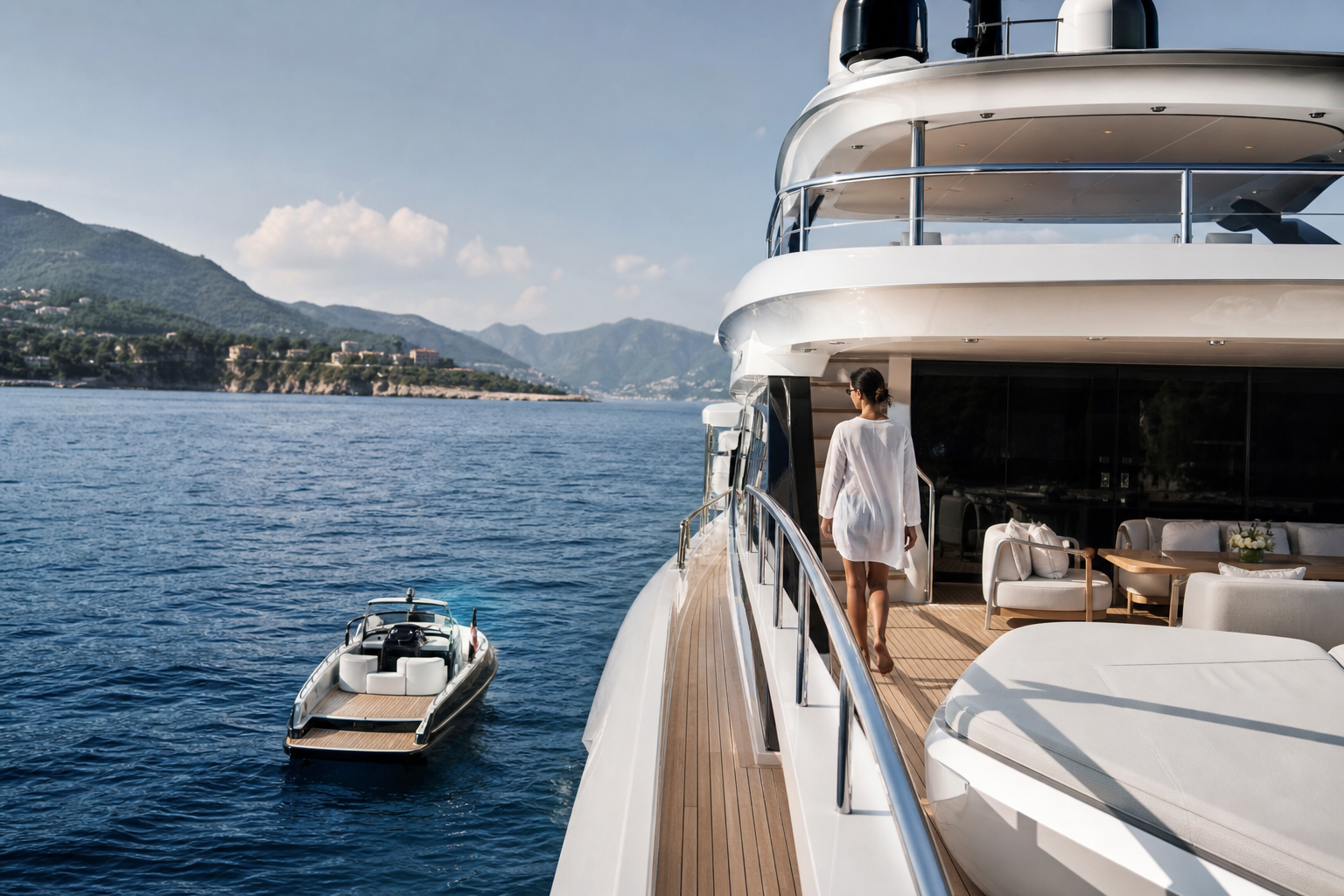
A more typical day aboard looks roughly like this: a leisurely breakfast on the aft deck, a few hours of emails and video calls in the shade, a swim off the stern platform, children working through an inflatable slide for the fourth afternoon in a row, cocktails with a small group at dusk and an early night before a passage. It is closer to a very private, very well-staffed family resort than to anything that would make compelling television.
Much of what passes for entertainment is low-key and multi-generational. Films in the cinema room, board games, teenagers in gaming dens, grandparents in a shaded saloon while younger family members cycle through jet skis and shore trips. On longer voyages, routines tend to settle in: set mealtimes, agreed gym or yoga slots, quiet hours when crew turn down music and lights, and the same favourite anchorages revisited each season as part of a family’s rhythm rather than a restless hunt for the next spectacular location.
The toys and tech are real, but their actual use is more practical than cinematic. Tenders function primarily as shuttles to discreet restaurants or small ports. Jet skis and seabobs are administered under tight safety rules. The cinema and AV system gets as much use for children’s films and live sport as it does for anything glamorous. Owners and senior guests often structure their days around resistance pool sessions, personal training, massages and reading, using the yacht more as a high-privacy wellness retreat than a nightclub.
Having children, nannies and grandparents aboard pulls the tone decisively away from Below Deck chaos and towards something closer to an ultra-private hotel with occasional big nights layered in, rather than the reverse. Superyachts can absolutely cross the ocean, and on such extended passages, the multi-generational, resort-like rhythm becomes even more pronounced. Oprah, returning from a trip aboard David Geffen’s 454-foot Rising Sun, was asked what happened on board. Her answer: ‘We talked, and everybody else did a lot of paddleboarding.’
The Choreography Behind Superyacht Lifestyle Entertainment
Pull back the curtain and what you find is not glamour but stage management, executed at considerable personal cost to the people doing it. A typical guest day for crew, as described by a working stew, starts before seven in the morning and ends when the last guest goes to bed, sometimes around midnight, with service, cleaning, watch-keeping and toy management running in overlapping shifts throughout. If the yacht moves overnight, that adds another hour or two on deck handling lines and fenders.
Every apparently effortless lunch or watersports afternoon is the product of extensive preparation: provisioning in bulk (on one voyage, crew unloaded a truck of meat to last four months), liaising with ports and agents, checking weather and swell, setting up and testing equipment, and rehearsing service so that nothing looks rehearsed from the guest side. Maritime safety runs as an invisible frame around all of it, from passenger headcounts before tenders go to shore, to briefings before guests use jet skis or dive gear, to quiet intervention when someone pushes against agreed limits.
Good crew also manage something harder to quantify: the emotional labour of knowing when to be invisible and when to anticipate, of filtering requests through what is legal and safe, and of protecting guests’ privacy while maintaining their own wellbeing under relentless professional pressure. A 2018 survey by the International Seafarers’ Welfare and Assistance Network found that more than half of women working as yacht crew had experienced harassment, discrimination or bullying on board, and more than four-fifths of all respondents reported low morale. The reality TV version focuses on gossip; the real pressure points are fatigue, compressed timelines and the emotional demands of delivering perfect holidays to exceptionally powerful people.
From the captain’s perspective, superyacht entertainment is ultimately a form of production design: crew, lighting, music, timing and toys all orchestrated so that, from the guest side, the yacht simply feels like the one place where everything works and nothing is ever awkward. The invisibility of that effort is the point.
How to Think and Talk About Superyacht Life More Realistically
If you are considering a charter, the most useful reframe is this: treat the yacht as an ultra-private family resort with a working-retreat function and the capacity for one or two genuinely unforgettable parties, rather than expecting a week-long festival at sea. Before you book, discuss with the captain or broker the balance you actually want between quiet days and big nights, how much structure versus flexibility suits your group, any work demands that will shape the schedule, children’s routines, and where you sit on the question of privacy, including social media use aboard.
If you are considering working on board, the trade is access to extraordinary places and people in exchange for long hours, a strict hierarchy and a duty of discretion that does not clock off. Seek out captains and vessels with a reputation for professionalism and crew welfare, not just glamour. The gap between the shiniest portrayals and the actual working conditions remains wide enough to matter.
For writers and commentators, there is a richer story available than either uncritical celebration or moral outrage. Superyachts function simultaneously as floating homes, mobile offices, status stages and family retreats, and acknowledging the excess while also conveying the logistics, the labour and the genuine human texture of life aboard produces something more durable than another piece about champagne fountains.
Ultimately, understanding the gap between the screenplay and the wake is useful for everyone involved. Guests arrive with better questions and more realistic expectations. Crew can set clearer boundaries when clients know what is reasonable to ask for. And anyone writing or talking about this world can learn to decode what is performance, the carefully managed visibility that researchers like Emma Spence observed in the ports of the Côte d’Azur, and what is simply people, however wealthy, trying to rest somewhere they cannot easily be found.